
by James A. Bacon
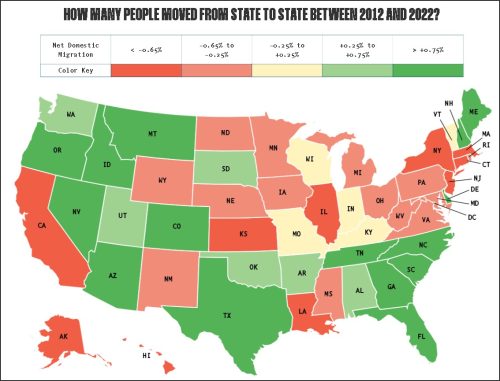
Virginia lost a net of 120,000 residents through domestic migration (excluding foreign immigration and emigration) over the decade between tax years 2011-12 and 2021-22, according to the Unleash Prosperity “Vote with your feet” database. That was the 9th worst performance among the 50 states.
That out-migration translated into a loss of $14 billion in adjusted gross income, or an average of $117,000 per person — not per household, but per person. On average, the households leaving Virginia were affluent. The loss of prime taxpayers translates into roughly $800 million in lost state income-tax revenue.
No surprise to anyone paying attention: Florida, Texas and North Carolina were the big winners. New York, California and Illinois were the big losers. Sadly, Virginia was the only loser on the South Atlantic Coast, one of the fastest growing regions of the country.
“The single most important thing that is going on in this country, economically and demographically, is the massive shift in migration that’s happened over the last 10 to 20 years, and it is accelerating,” economist Steve Moore told attendees at the launch of the Unleash Prosperity website.
Interestingly, Gov. Glenn Youngkin took time out of his schedule to speak at the unveiling. According to The Daily Signal, he attributed the population shift to what the news outlet described as “a virtuous cycle in red states of cutting or eliminating state income taxes, which led to a greater influx of people and jobs, which created a larger tax base and more revenue for state budgets.”
One of Youngkin’s legitimate bragging points is that Virginia has reversed the outflow of talent during his tenure as governor. “In 2023 for the very first time,” he said, “Virginia broke the mold, and we were number nine in the nation for net in-migration, coming from number 40 the year before.”
“Those people are going to bring with them their income, and they’re going to pay taxes, and then we have a surplus, and with that surplus we get to invest in education and law enforcement and behavioral health, and we get to reduce taxes again,” Youngkin said. “This virtuous cycle actually works, and we know it works because that is what we’ve unleashed in the Commonwealth of Virginia.”
Let me say that Youngkin has pursued sound fiscal and economic policies, and I think he’s right that people do respond to taxes — along with other factors contributing to the cost of living such as housing and energy prices.
But I would hesitate to attribute the domestic migration turnaround to the factors Youngkin cited. He has cut taxes…. a little. But so little that no one notices. He has funneled more money into education and law enforcement. But Virginia’s educational-achievement rankings haven’t improved much, and violent crime is down nationally, not just in Virginia. The significance of these metrics is ambiguous.
What the Governor can say indisputably is that Virginia has run consistent budget surpluses and built up its financial reserves. Otherwise, his main contribution has been wielding his veto pen. Unrestrained, Democratic lawmakers would have unleashed a flood of costly legislation that would have made Virginia’s competitiveness infinitely worse.
It wouldn’t have been long before I would have been compelled to the Old Dominion as South Jersey. (New Jersey, by the way, ranked No. 4 in the list of top losers). When Blue states are actively digging their own graves, maybe all it takes is for Virginia to put down the shovel.
I put zero significance in Virginia’s decline from No. 1 to No. 4 in CNBC’s best states for business ranking (or its previous elevation to No. 1). The shift in ranking reflected CNBC tweaks to its methodology, not to anything that Virginia had done to address fundamentals. Virginia’s business climate was good last year, and it’s good this year. Many factors influence a state’s competitiveness in attracting people. Some economic sectors outperform others over long stretches of time. A state’s legacy industrial mix is not something that any single governor can change.
Still, I credit Youngkin with recognizing the importance of the domestic migration as a marker of economic prosperity. He understands what makes the economy tick. His policies are sound. But I instinctively rebel when public officials take credit for developments that likely are beyond their control.
Leave a Reply
You must be logged in to post a comment.